
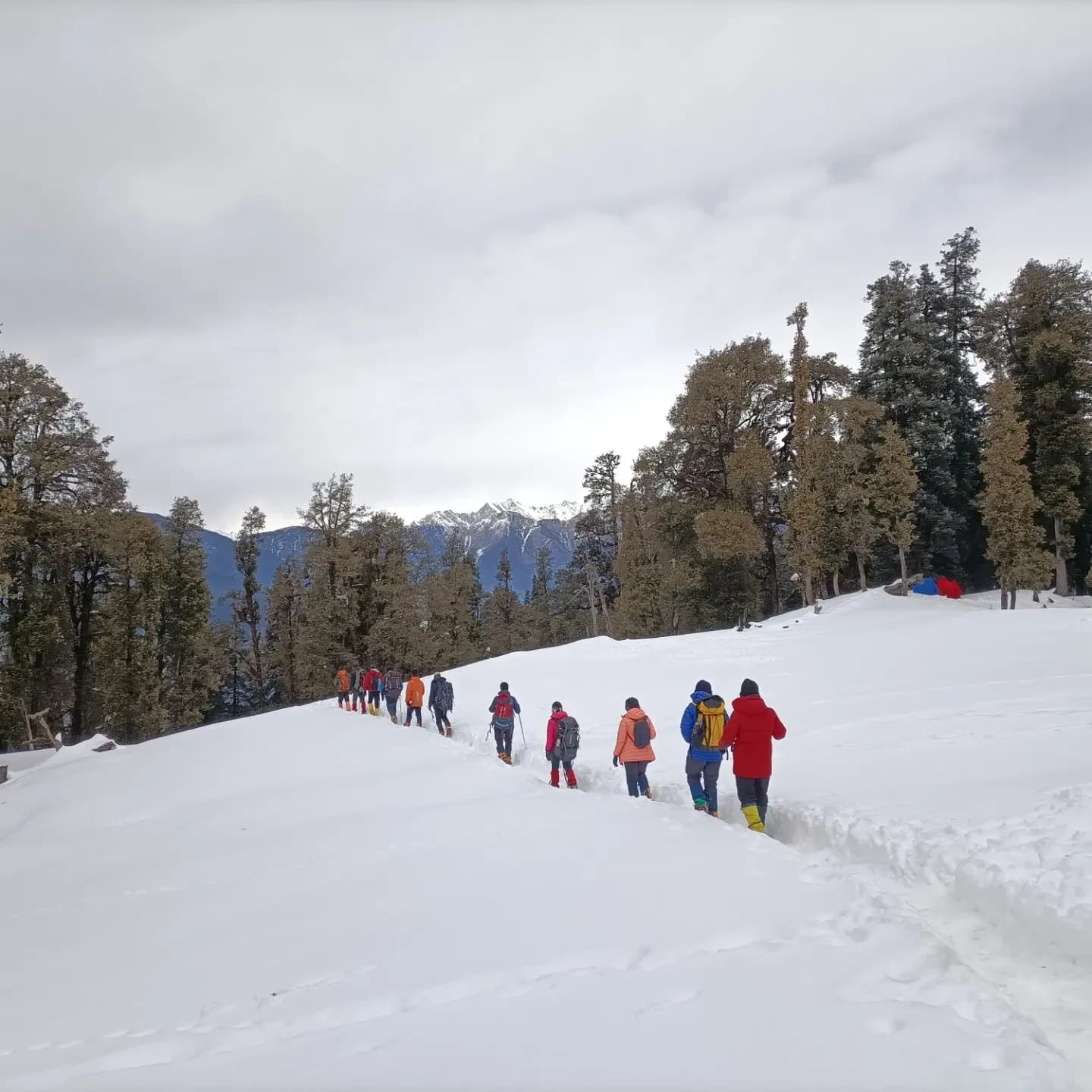
Kedarkantha is a 5-day, 4-night snow trek in Uttarakhand that reaches a 12,500 ft (3,810 m) summit. It is rated easy to moderate and is open to anyone aged 10 and above with basic fitness and a doctor's medical certificate. With Mountthrill, the trek costs from ₹3,999 per person. The trek starts from Sankri village, about 200–220 km and 7–8 hours of driving from Dehradun.
This comprehensive guide covers everything you need to plan your trek: transparent package costs, a realistic day-by-day itinerary, seasonal snow conditions, trail difficulty, packing essentials, and first-hand safety notes recorded directly by our Dehradun operations team and trail leaders.
Ready to stand on the Kedarkantha summit?
Check verified winter batch dates, live seat availability, and book your slot with a 25% advance.
Kedarkantha trek at a glance
Key specifications and verified logistical facts for quick reference before planning:
How much does the Kedarkantha trek cost?
At Mountthrill, pricing is 100% upfront with zero hidden charges. The total cost depends solely on your chosen pickup point:
← Swipe table to see all details →
| Package Tier | Price per Person | What is Included |
|---|---|---|
| Sankri to Sankri | ₹3,999 | You reach the Sankri base village on your own. Includes all accommodation, meals, camping gear, microspikes, and permits. |
| Dehradun to Dehradun | ₹5,499 | Round-trip shared transport from Dehradun Railway Station to Sankri and back, plus the full trek package. |
| Delhi to Delhi | ₹6,999 | Round-trip transport from Delhi to Sankri and return journey, plus the full 5-day trek package. |
✓ What is included:
- • Accommodation: Homestay in Sankri (Day 1) and quality 3-season alpine tents on the trail (triple/quad sharing).
- • All Meals: Day 1 dinner through Day 5 breakfast. Wholesome, energising vegetarian food, morning tea, and hot soup.
- • Camping Equipment: Clean sleeping bags rated to -10°C, insulated sleeping mats, and separate dining and toilet tents.
- • Technical Snow Gear: Microspikes, gaiters, and ice axes provided free of cost whenever snow conditions demand.
- • Medical & Safety: Mountaineering-qualified trek leaders (NIM/ABVIMAS certified), emergency oxygen cylinder, pulse oximeter, first aid kit, and stretcher.
- • Permits: Govind National Park entry permits, camping fees, and forest department clearances.
✕ What is NOT included:
- • Personal Clothing & Gear: Jackets, trekking boots, thermal inners, gloves, and backpacks (rentals available at Sankri base).
- • Backpack Offloading: Trekkers carry their own packs. Mule/porter offloading can be arranged in advance for ₹1,200–₹1,500 for the full trek.
- • Road Journey Meals: Breakfast and lunch stops during the drive between Dehradun and Sankri (approx. ₹200–₹300 per meal).
- • Insurance: High-altitude adventure medical and rescue insurance (strongly recommended).
- • Emergency Evacuation: Any cost arising from unforeseen medical evacuation, roadblock delays, or personal emergencies.
Booking & Cancellation Policy
Payment terms: Pay a 25% deposit to lock in your batch departure slot. The remaining 75% balance is due at least 15 days prior to the trek start date.
Flexible reschedule: We provide one free date transfer up to 15 days before the departure date, subject to available seats in the requested batch.
| Cancellation Window | Refund Amount |
|---|---|
| 30 or more days before departure | 90% refund |
| 15 to 29 days before departure | 50% refund |
| 7 to 14 days before departure | 25% refund |
| Less than 7 days or no-show | No refund |
Kedarkantha trek itinerary (day by day)
A realistic, altitude-graded breakdown of what each day on trail entails, including trail timings, elevation gains, and campsite expectations:
Dehradun to Sankri (6,400 ft)
The team gathers at 6:30 AM outside Dehradun Railway Station. Boarding our mountain tempo travellers, the route snakes past the Mussoorie bypass, crosses the Yamuna river at Damta, climbs up through Purola, and follows the Tons and Supin river gorges through Mori and Naitwar. If you arrive in Dehradun a day early to explore, browse our complete guide to trekking in Dehradun for the best nearby trails.
You arrive at Sankri village between 4:30 PM and 5:30 PM. Check into our traditional village homestay, unpack, and gather for the evening orientation. Your trek leader verifies your government IDs, collects medical forms, and conducts a mandatory gear inspection. A hot home-cooked dinner is served. Sankri is the final point with erratic mobile connectivity (BSNL/Jio)—make your last phone calls home tonight.
Sankri to Juda-ka-Talab (9,100 ft)
Your trek officially starts from the wooden trail arch behind Sankri village. The route climbs through dense pine, cedar, and golden oak forest, gaining approximately 2,700 ft of altitude over 4 km. The gradient is continuous and steady, testing your leg endurance right from morning.
Around midday, you emerge into a small clearing cradling Juda-ka-Talab, a high-altitude lake ringed by giant pine trees. From late December through February, the entire lake surface freezes into thick blue-white ice. We pitch our 3-season alpine tents on the snow-dusted meadow clearing beside the lake. Separate dry eco-toilet tents are stationed nearby. Mobile signal ceases completely today.
Juda-ka-Talab to Kedarkantha Base Camp (11,250 ft)
A shorter, visually rewarding trekking day. As you climb out of the pine tree line, the dense forest gives way to expansive alpine meadows (bugyals) buried deep under snow in winter. The conical summit pyramid of Kedarkantha looms in clear view ahead.
You reach Kedarkantha Base Camp (11,250 ft) by approximately 1:00 PM in time for a hot lunch. The afternoon is dedicated to safety preparation: trek leaders fit your microspikes and gaiters, teach you the rhythmic footwork needed on hard snow, and demonstrate ice axe self-arrest fundamentals. Dinner is served early at 6:30 PM, and lights-out is strictly enforced by 7:30 PM because the summit push begins in the middle of the night.
Kedarkantha Summit (12,500 ft) & Descent to Juda-ka-Talab
Wake-up call is between midnight and 2:00 AM, calibrated by the trek leader based on real-time weather and snow conditions. With headlamps illuminating the frozen snow trail, the team ascends the steep summit ridge under a vast canopy of Himalayan stars.
You reach the 12,500 ft (3,810 m) summit right as the first golden rays break over the Garhwal Himalaya. At the summit sits a sacred stone shrine dedicated to Lord Shiva. The 360-degree panorama reveals majestic peaks: Swargarohini, Bandarpoonch, Kala Nag (Black Peak), and the Gangotri range.
On the descent back to Base Camp, snow conditions often allow safe, controlled glissading (snow slides) down designated gullies under direct guide supervision. After hot tea and lunch at Base Camp, we continue the descent down to the sheltered forest clearing at Juda-ka-Talab for our final camping night. *Note: Reaching the summit is subject to safe weather conditions and trekker fitness. The trek leader's decision is absolute.
Juda-ka-Talab to Sankri, Drive back to Dehradun
We leave camp at 8:00 AM for the relaxed 4 km descent through the pine forest back to Sankri, arriving around 11:00 AM. Trekkers can freshen up at the homestay and collect any luggage left behind in cloak storage.
By 12:00 noon, our transport departs Sankri for Dehradun. You reach Dehradun Railway Station between 9:00 PM and 10:00 PM. Important travel tip: Mountain roads are prone to traffic delays; never book return flights or trains before 11:30 PM on Day 5, or preferably plan an overnight stay in Dehradun.
When is the best time to do the Kedarkantha trek?
Kedarkantha is accessible 10 months a year, but each season offers a fundamentally different mountain experience. For deep snow, choose December to February. For blooming rhododendrons and milder temperatures, pick March or April. For crystal-sharp Himalayan views, pick October or November. The trek is closed in July and August due to monsoon landslide risks along the Purola–Mori road. If you are comparing multiple winter destinations, take a look at our curated list of winter treks in India.
← Swipe table to see all seasons →
| Season | Months | Trail Conditions & Highlights |
|---|---|---|
| Winter | Dec–Feb | Peak snow season. Continuous snowpack from Juda-ka-Talab to summit. Frozen lake, knee-deep snow, sub-zero tent nights. Most iconic time. |
| Spring | Mar–Apr | Snow melting on lower ridges, scarlet and pink rhododendron forests in full bloom. Pleasant daytime sun, easier footing. |
| Summer | May–Jun | Vibrant green alpine meadows, wildflowers, comfortable temperatures. Ideal for beginners, children, and senior trekkers. |
| Autumn | Sep–Nov | Crisp, washed-clean post-monsoon air. Clearest mountain vistas of the year, golden oak foliage, zero snow obstruction. |
Ground-Truth Snow Depth & Base Camp Temperatures
Snow depth varies every winter depending on Western Disturbances, but our trail logs record the following consistent benchmarks across seasons:
- December: Snow typically begins near Juda-ka-Talab (9,100 ft). Mid-December brings 1 to 2 feet of fresh powdery snow on the upper ridges. Night temperatures at Base Camp hover between -3°C and -6°C.
- January & February (Deep Snowpack): Juda-ka-Talab freezes solid. Base Camp (11,250 ft) routinely accumulates 3 to 5 feet of snow, with wind-drift gullies near the summit approach exceeding 6 feet. Night temperatures at Base Camp plunge to -8°C to -12°C, with our lowest recorded Base Camp thermometer reading touching -15°C during active winter snowstorms.
- March: The lower trail through the forest thaws into mud and ice, while Base Camp through the summit ridge retains 2 to 3 feet of hard-packed snow. Early morning pushes require microspikes until midday sunshine softens the surface.
*Mountthrill trail rule: Always pack clothing rated for the extreme lower end of this temperature range (-15°C wind chill factor).
Is Kedarkantha difficult?
Kedarkantha is graded easy to moderate. You do not need technical mountaineering skills, ropes, or prior trekking experience. However, it is not a casual stroll. You will be walking with a backpack on snowy ascents and sleeping in freezing alpine conditions.
Most of the challenge on Kedarkantha originates from three specific factors:
The Day 2 Climb
You gain 2,700 ft of vertical elevation in just 4 km out of Sankri. Pacing yourself from the first step is essential to avoid burning out your calves and quadriceps.
Summit Night Endurance
Waking up at midnight to 2:00 AM to climb in the freezing dark for an 8–10 hour round trip. Carry a reliable headlamp with spare batteries, not a handheld phone torch.
Sub-Zero Cold
Temperatures fall sharply at Base Camp. A single heavy jacket is not enough; survival and comfort depend on a proven 4-tier layering system.
What Really Stops People on Kedarkantha?
In our trail logs, over 80% of trekkers who fail to reach the summit drop out not because of physical weakness or altitude, but due to two specific behavioural mistakes:
1. The Day 2 Pacing Mistake: Trekkers feel fresh in the crisp pine air leaving Sankri and rush up the first 2,700 ft ascent to Juda-ka-Talab. Within two hours, their legs are full of lactic acid. Mountthrill leaders enforce the "Mountthrill Micro-Step": small, rhythmic steps where the heel touches the toe at an unhurried tempo. Trail rule: If you cannot breathe easily through your nose during the ascent, you are moving too fast.
2. The Base Camp Sleep Mistake: On Day 3 at Base Camp, trekkers are excited and stay up talking inside tents until 10:00 PM. When the 1:00 AM summit call arrives, sleep deprivation combined with -10°C cold triggers exhaustion. Our leaders enforce an absolute 7:30 PM tent quiet hour, mandate 3 litres of hydration before 6:00 PM, and serve hot garlic soup to aid circulation before bed.
Understanding Altitude Sickness (AMS)
Acute Mountain Sickness can affect anyone above 8,000 ft, regardless of fitness level. Watch for early warning signs: persistent throbbing headache, nausea, loss of appetite, dizziness, or unusual fatigue. Report symptoms to your trek leader immediately. Every Mountthrill batch carries medical oxygen cylinders and digital oximeters. If symptoms persist, the leader will arrange an immediate descent to Sankri. The leader's safety decision is final.
How to prepare: fitness, documents, and packing
1. Physical Fitness Plan
Start training 3 to 4 weeks before your departure date. Your primary goal is cardiovascular endurance and leg stamina:
- Aerobic benchmark: Be able to jog or brisk-walk 5 km in 35–40 minutes without stopping.
- Stair climbing: Climb 30–40 flights of stairs daily (or use a stairmaster) with a 4–5 kg daypack to prepare your knee joints.
- Lower body strength: Do 3 sets of 15 bodyweight squats, lunges, and calf raises 3 times a week.
*Inform Mountthrill advisors during booking if you have any history of asthma, high blood pressure, heart ailments, diabetes, or epilepsy.
2. Age Limit & Mandatory Documents
The minimum age limit is 10 years. There is no rigid upper age limit, provided the trekker is active and cleared by a physician. Every trekker must carry:
3. Winter Packing Checklist
Pack light, functional gear. Weather in the Himalayas changes rapidly—dress in layers:
← Swipe table to see all items →
| Gear Category | Essential Items |
|---|---|
| Footwear | High-ankle, water-resistant trekking shoes with deep lugged soles (e.g., Forclaz Trek 100). 3 pairs quick-dry cotton socks + 2 pairs woollen socks. |
| Cold Layers | 2 sets thermal inners (merino wool or polyester), 1 warm fleece jacket (200 GSM), and 1 down or heavy padded jacket rated to -10°C. |
| Outer Shell | 1 windproof/waterproof jacket with hood and 1 waterproof trekking pant or full rain poncho. |
| Head & Hands | 1 woollen beanie/balaclava, 1 sun cap, UV sunglasses with side protection (Cat 3/4), 1 pair fleece gloves + 1 pair waterproof ski gloves. |
| Hardware & Trekking | 50–60 L backpack with waterproof rain cover, 1 pair trekking poles with snow baskets, and a headlamp (with spare batteries). |
| Hydration & Toiletries | Two 1-litre insulated thermos flasks (essential for warm water in freezing temps), lip balm with SPF, biodegradable wet wipes, and cold cream. |
*Microspikes and snow gaiters are provided free of cost by Mountthrill. Personal gear (jackets, trekking boots, poles) can be rented at Sankri base, subject to advance booking.
Things to arrange before reaching Sankri
Cash & Banking
The last working ATMs are at Purola and Mori, but they frequently run out of cash. UPI digital payments fail in Sankri due to network blackouts. Withdraw ₹3,000 to ₹5,000 cash in Dehradun or Mussoorie for mule offloading, gear rentals, and personal snacks.
Power & Batteries
Sankri has intermittent village grid power with paid charging points (₹50–₹100 per device). There is zero electricity at Juda-ka-Talab or Base Camp. Sub-zero cold drains lithium batteries rapidly; bring a 20,000 mAh power bank and sleep with your phone inside your sleeping bag.
Onward Return Travel
The drive from Sankri to Dehradun takes 7 to 8 hours and can be delayed by landslides, snow clearance, or Doon city traffic. Do not book return flights or trains before 11:30 PM on Day 5, or schedule your departure for the following morning.
Medical Facilities
The nearest Primary Health Centre (PHC) is at Mori (22 km) and Purola (54 km). The nearest tertiary hospital is 7–8 hours away in Dehradun. Mountthrill leaders carry medical oxygen, first aid, and stretchers for on-trail stabilization.
Frequently asked questions
Clear, straightforward answers to the most common questions asked by prospective Kedarkantha trekkers:
Is Kedarkantha good for beginners?
Yes. It is rated easy to moderate and needs no prior trekking experience. You do need basic fitness, meaning you can walk 5 km in 35–40 minutes, and a doctor's medical certificate.
What is the cost of the Kedarkantha trek?
It starts at ₹3,999 per person from Sankri. The Dehradun round-trip package is ₹5,499 and the Delhi round-trip package is ₹6,999.
How many days does the Kedarkantha trek take?
Five days and four nights from Dehradun: one day of driving to Sankri, three days of trekking, and one day for the descent and drive back.
What is the height of Kedarkantha?
The summit is at 12,500 ft (3,810 m).
How long is the Kedarkantha trek?
The total trekking distance is about 20 km over three trekking days.
What is the age limit for Kedarkantha?
The minimum age is 10 years. There is no fixed upper age limit, but every trekker needs a medical certificate confirming fitness for high-altitude trekking.
How far is Sankri from Dehradun?
About 200–220 km. The drive takes 7–8 hours, and closer to 10 with meal stops, via Mussoorie, Purola, Mori and Naitwar.
Is there mobile network on the Kedarkantha trek?
Network is limited at Sankri and unavailable from Day 2 onward. Inform your family before you leave Sankri.
Are oxygen cylinders carried on the trek?
Yes. Every batch carries a first aid kit, oxygen cylinder, oximeter and stretcher.
What happens if the weather is bad on summit day?
The trek leader may delay, shorten or stop the summit push. Safety decisions are final, and the summit is never guaranteed.
What is the refund policy?
Cancel 30 or more days before: 90% refund. 15–29 days: 50%. 7–14 days: 25%. Less than 7 days or no-show: no refund. One free date change is allowed up to 15 days before the trek.
Ready to experience Kedarkantha with Mountthrill?
Book your certified winter trek with Dehradun's local mountaineering leaders. Transparent pricing from ₹3,999, small batch sizes, and safety-first mountain logistics.
Ready to Summit Kedarkantha (12,500 ft)?
Join small batches of 15 trekkers led by certified Dehradun mountaineers. Complete safety gear, hot mountain meals, and transparent pricing with zero surprise charges.
Not Sure Which Trek Is Right for You?
Talk to a Mountthrill Trek Advisor. We'll understand your experience level, fitness, and travel dates — and find the perfect match from our catalogue.
Free consultation · No commitment · Instant response on WhatsApp
More from the Journal

Trekking in Dehradun: Where to Go, When, and How Hard It Is
Day hikes near Mussoorie, weekend treks like Nag Tibba, and snow and meadow treks from Dehradun. Distances, seasons and levels, by Mountthrill.
Munsiyari & Darma Valley: 8-Day Family Trip from Delhi
8-day family itinerary: fly Delhi to Pithoragarh, explore Munsiyari, camp near Khaliya Top and stay in a Darma Valley homestay. Kid-friendly pace, season tips.

Founder-Led Adventure Series
Journey with MonkTrekker
Once a month, MonkTrekker personally leads one small-group Himalayan journey — not a standard package, but a route chosen for what it teaches, not just where it goes. Expect backpacking over marked trails, unscheduled stops in villages most itineraries skip, campfire conversations that run late, and a pace built for actually being there, not just getting through it.
January 2027
Karchon – Dhurkund – Joshimath – Auli
An 8-day founder-led journey across Karchon, Dhurkund, Joshimath, and Auli. Features scenic winter day hikes, authentic local culture, and an unforgettable one-night alpine camping experience under the Himalayan stars. Capped at 12 trekkers.